E-bikes are changing the way people get around — for the commute, for errands, or just for the fun of it. If you're moving from a regular bike to an e-bike, the switch can feel unfamiliar at first, but it's easier than it looks. This guide covers what makes an e-bike different, how to get ready for your first ride, a simple step-by-step way to build up your skills, and the rules you need to know whether you're riding in the US, the UK, or Australia.
What's Different About Riding an E-Bike?
An e-bike is really just a regular bike with a few clever electronic parts added on. The wheels, handlebars, pedals, and brakes all work the same way — the electronics are what change the experience.
Motor and battery. The motor gives the rear or front wheel extra power, and the battery keeps everything running. Both add weight, so compared to a regular bike, an e-bike tends to feel more stable and planted, with noticeably more push behind every pedal stroke.
Pedal-assist. Most e-bikes use a pedal-assist system, so you're not doing all the work yourself. Sensors detect that you're pedaling and add power to match. Once the cranks start turning, you'll feel a smooth boost kick in — hills and headwinds stop being a big deal.
Faster acceleration. Thanks to the motor, an e-bike gets up to speed faster than a regular bike. Once you reach a cruising speed — often somewhere around 15–20 mph (24–32 km/h) — holding that pace takes barely any effort at all.
Getting Ready for Your First Ride
Do a quick pre-ride check. It's always worth a once-over before you head out, especially since e-bikes move quicker than regular bikes. Check that your tires are at the right pressure for good grip and a smoother ride, squeeze the brake levers to confirm they're working, and make sure the battery is securely seated and has enough charge for where you're going.
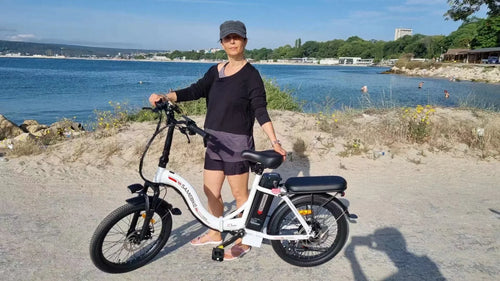
Get your fit and position right. Once your saddle height is dialed in, everything else falls into place. You should be able to sit comfortably with the balls of your feet reaching the pedals — or at least touch your toes down when stopped, so you can stay balanced. Riders who want an easier time getting on and off, or a more relaxed ride overall, often find a step-through frame makes those first few rides much less intimidating.
Learn the controls before you roll. While the bike is still standing still, get familiar with every control: the power button, the assist-mode switch, and the display. Find them all before you set off, so you're not hunting around for buttons once you're moving.
Wear the right safety gear. Proper gear isn't optional. Wear a helmet on every ride. Since e-bikes travel faster and share the road with traffic, bright or reflective clothing helps you stay visible, and shoes with a secure grip keep your feet planted on the pedals.
Pick a safe place to practice. For your very first ride, skip busy streets. Find somewhere flat and quiet — an empty parking lot, a weekend school lot, or a quiet dead end — free of traffic and distractions, where you can get a real feel for how the bike handles.
How to Ride an E-Bike, Step by Step
Step 1: Start on low assist. Power on the bike and set the assist to its lowest level — often labeled "Eco" mode. Starting on a high-power setting can catch you off guard: the motor kicks in hard the moment you push the pedals, which can throw off your balance.
Step 2: Ride slowly and find your balance. Get on, push off, and pedal like you would on a regular bike. The motor will add a gentle push — don't fight it. Relax your grip on the bars, keep your eyes up and looking ahead, and you'll be fine.
Step 3: Practice turning and braking. Ride a few slow, wide circles to get a feel for the bike's weight and how it turns. For braking, apply both levers evenly and smoothly. Because the bike is heavier and quicker, give yourself more stopping distance than you would on a regular bike.
Step 4: Build up your speed gradually. Once turning and braking feel natural, you can bump the assist level up a notch. Pedal at a steady pace and get used to the extra push. Take it slow, build speed in stages, and stay aware of the bike's speed limit and how it responds.
Step 5: Practice stopping safely. To stop, just ease off the pedals — the motor cuts out right away. Then squeeze both brakes gently to come to a smooth, controlled stop. Put a foot down to steady yourself, then power off.
Building Confidence as a New Rider
Start with short rides. Keep your first few outings brief — 15 to 20 minutes is plenty. That gives your muscles and reflexes time to adjust to the extra weight, quicker acceleration, and longer stopping distance. There's no need to push yourself before you've got the hang of it.
Understand your range and ride modes. Different assist levels use battery at different rates. A high-power mode drains the battery fast; an eco mode stretches your range much further. If you're commuting, riding along the coast, or covering light gravel, steady and predictable power usually beats raw speed.
Choose beginner-friendly routes. For your early rides, stick to dedicated, smooth bike paths or quiet residential streets with light traffic and gentle grades. Skip busy intersections, construction zones, and rough terrain until you've built up your skills.
Ride defensively. Most people on the road or path won't expect an e-bike to be moving as fast as it is. Ride as if you're invisible — leave extra space around parked cars, give a light bell ring or call out when passing pedestrians, and stay alert to what's happening ahead.
E-Bike Rules by Market
E-bike laws vary quite a bit by country — and in some cases, by state or region within a country. Here's a quick, practical overview for the three markets Samebike ships to most.
United States
The US doesn't have one federal e-bike law; instead, most states have adopted a common three-class system:
- Class 1 — pedal-assist only, motor cuts off at 20 mph (32 km/h)
- Class 2 — includes a throttle, also capped at 20 mph (32 km/h)
- Class 3 — pedal-assist up to 28 mph (45 km/h), often with added requirements like a minimum age or helmet rule
Class 1 and 2 e-bikes are generally welcome on bike lanes and multi-use paths; Class 3 bikes are usually limited to roads and on-road bike lanes. Because rules can vary by state and even by city, it's worth checking local regulations before riding somewhere new. One trend worth flagging for 2026: more cities and transit authorities are requiring UL-certified batteries (UL 2849 or UL 2271) for fire safety, so it's worth choosing an e-bike with certified components.
United Kingdom
In the UK, e-bikes fall under the EAPC category — Electrically Assisted Pedal Cycle. To qualify, a bike must have a motor no more powerful than 250W, provide pedal-assist only (no throttle-only "twist and go" operation), and cut off assistance at 25 km/h (about 15.5 mph). An EAPC that meets these specs is treated just like a regular bicycle: no license, registration, tax, or insurance required, and riders must be at least 14. A helmet isn't legally required for adults, though it's strongly recommended. Anything that exceeds these limits is legally treated as a moped or motorcycle, with all the licensing and insurance requirements that come with it.
Australia
Australia's e-bike rules are tightening and converging around a single national standard: 250W continuous motor power, pedal-assist only, certified to the EN 15194 standard, with assistance cutting off at 25 km/h. A throttle is allowed only for "walk assist" up to 6 km/h, or as a boost while you're actively pedaling — it can't propel the bike on its own past that speed. Unlike the UK, a helmet is mandatory for all riders in Australia. Enforcement has become notably stricter in 2026, with several states introducing roadside power/speed testing and the power to seize non-compliant bikes, so it's especially important to ride a bike that's certified for the Australian market rather than one that's been "unlocked" for extra speed.
The bottom line across all three markets: a compliant, pedal-assist e-bike is treated like a bicycle — simple, low-friction, and welcome on most bike infrastructure. Push past the local power or speed limit, and you cross into moped or motorcycle territory, with registration, insurance, and licensing to match. Always check your specific state, province, or local council rules, since they can add extra layers on top of the national standard.
Frequently Asked Questions
Can I ride an e-bike if I'm not confident on a regular bike? Yes. The motor provides steady, consistent power, which actually makes it easier to keep your balance — you don't have to work hard to keep the pedals turning, which cuts down on wobbling and helps you stay upright.
Are e-bikes too heavy for a beginner? Not really. The motor does help offset the extra weight the moment you start pedaling. E-bikes are heavier, no question — but once you're moving, a well-balanced frame handles a lot like a regular bike.
Can I ride an e-bike on the sidewalk? It depends on local law, but as a rule, e-bikes shouldn't be ridden on sidewalks out of consideration for pedestrians. In most places, the right spot is the road, a bike lane, or a shared path — not the sidewalk.
Do I have to pedal to ride an e-bike? If your bike has a throttle, you technically don't — that's what makes it Class 2 in the US, for example. In the UK and Australia, throttle-only riding beyond a walking pace generally isn't legal; pedaling is required to unlock motor assistance at higher speeds.
Is riding an e-bike still good exercise? Definitely. You control how much assistance you use, so the workout is entirely up to you. And because e-bikes are easier to ride, people often use them more often and go farther — which usually adds up to more overall activity, not less.
Ready to Ride
Your first time on an e-bike? You're in for a good time. It's quick, it's efficient, and it'll likely take you farther than you expect. Check your gear, find a quiet spot to practice starting, turning, and stopping, and keep an eye on your battery. You'll find your rhythm quickly — there's no need to rush it. Go at your own pace, and enjoy the ride.